High-throughput, fully automated coating analysis for industrial paint development
Introduction
The paint and coatings industry continuously develops new resins and formulations to meet the demanding requirements of sectors such as automotive, aviation, and marine manufacturing. Each industry imposes unique performance expectations: automotive coatings must withstand road debris and harsh weather, aviation coatings must resist extreme temperature fluctuations, and marine coatings must endure saltwater exposure and UV degradation.
To ensure long-term durability and visual quality, coatings must undergo extensive analytical testing, including gloss measurements, colorimetric analysis, hardness testing, and layer-thickness evaluation.
Performing these measurements manually is labor-intensive, time-consuming, and prone to operator variability. To address this challenge, a fully automated high-throughput system the PaintButler platform was developed to streamline coating analysis, increase throughput, and deliver consistent, reproducible results.
Application purpose
Coated panels are the standard format for evaluating paint performance. Automating the handling of these large, rigid panels is challenging due to their size, weight, and the precision required for analytical positioning.
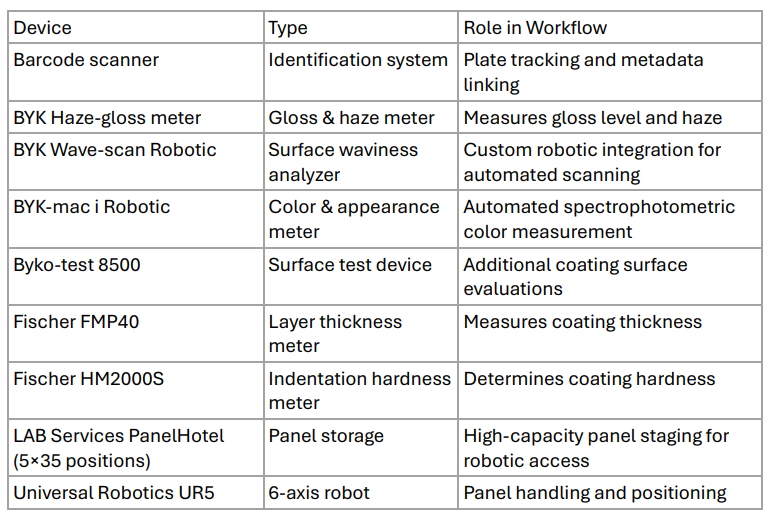
The PaintButler platform is engineered to process multiple panel types, including Bonder panels (105×190 mm) and Q-Panels (76×153 mm). These panels are stored in a custom-built PanelHotel (5×35 positions), designed and manufactured by Lab Services to ensure reliable robotic access.
A six-axis Universal Robotics UR5 robot equipped with a vacuum gripper provides full orientation freedom, enabling precise placement of panels onto each analytical instrument. Every panel is labeled with a barcode, allowing the system to determine which tests must be performed based on database-linked metadata.
PlateButler® Manager orchestrates the entire workflow, coordinating all devices and ensuring that each panel follows the correct sequence of measurements. Several analytical instruments including BYK devices and Fischer meters were modified by Lab Services to support fully automated operation.
This includes a custom automation solution for the BYK Wave-scan, which is normally a handheld rolling device. Lab Services engineered a robotic interface that preserves the instrument’s integrity while enabling automated, reproducible measurements.
Workflow Overview
Step 1 — Panel loading & registration
Panels are placed into the custom PanelHotel.
The barcode reader identifies each panel and retrieves the required test sequence from the database.
Step 2 — Robotic panel handling
The UR5 robot retrieves panels using a vacuum gripper.
Its six-axis flexibility allows precise orientation and positioning for each analytical device.
Step 3 — Automated analytical measurements
Panels are transported to the integrated instruments for sequential testing:
• Layer thickness (Fischer FMP40)
• Indentation hardness (Fischer HM2000S)
• Gloss & haze (BYK Haze-Gloss meter)
• Color & appearance (BYK-mac i Robotic)
• Surface texture & waviness (BYK Wave-scan Robotic)
• Additional surface tests (Byko-test 8500)
Step 4 — Smart protocol execution
PlateButler® Manager executes custom protocols that allow repeated measurements at increasing time intervals.
This enables detailed monitoring of coating behavior during curing and hardening.
Step 5 — Data output & workflow completion
All results are logged, stored, and linked to the panel barcode.
Panels are returned to the PanelHotel or routed to additional workflows.
Technical features
• Fully automated coating analysis for multiple panel formats
• Custom PanelHotel with 5×35 storage positions
• Six-axis robotic handling with vacuum gripper
• Automated barcode-driven test selection
• Smart protocols for repeated measurements during curing
• Modified BYK and Fischer instruments for robotic operation
• Automated 24/7 testing with minimal operator involvement
• Seamless workflow orchestration via PlateButler® Manager
Integrated devices
Results & impact
• Dramatic reduction in manual workload and operator variability
• High-throughput, reproducible coating analysis
• Automated handling of multiple panel formats
• Ability to perform repeated measurements during curing
• Increased consistency and reliability of analytical results
• 24/7 autonomous operation for maximum productivity
• Custom engineering enables automation of traditionally manual devices (e.g., Wave-scan)
Areas of application
• Automotive coatings
• Aerospace coatings
• Marine and industrial coatings
• Resin and polymer development
• Quality control laboratories
• R&D environments requiring high-throughput panel testing